
Maps, satellite images, and survey plots tell us the condition of a mangrove forest. But people who have lived beside that forest for decades hold knowledge no instrument captures: when and where shellfish may be gathered, which species are used as medicine, which places must not be disturbed. This article summarises four published examples of how local knowledge helps protect mangroves in Indonesia.
At a glance
- Effective mangrove management requires integrating local ecological knowledge, customary institutions, and gender equity (Paulangan et al., 2026).
- In Papua, Tonotwiyat, the Women’s Forest, governs access, harvesting rules, monitoring, and customary sanctions (Paulangan et al., 2026).
- In North Sumatra, 97% of respondents complied with mangrove management rules, which was linked to local wisdom (Sahputra et al., 2022).
- Mangrove ethnobotanical knowledge is still rarely documented and is mostly passed down orally (Ogi et al., 2026).
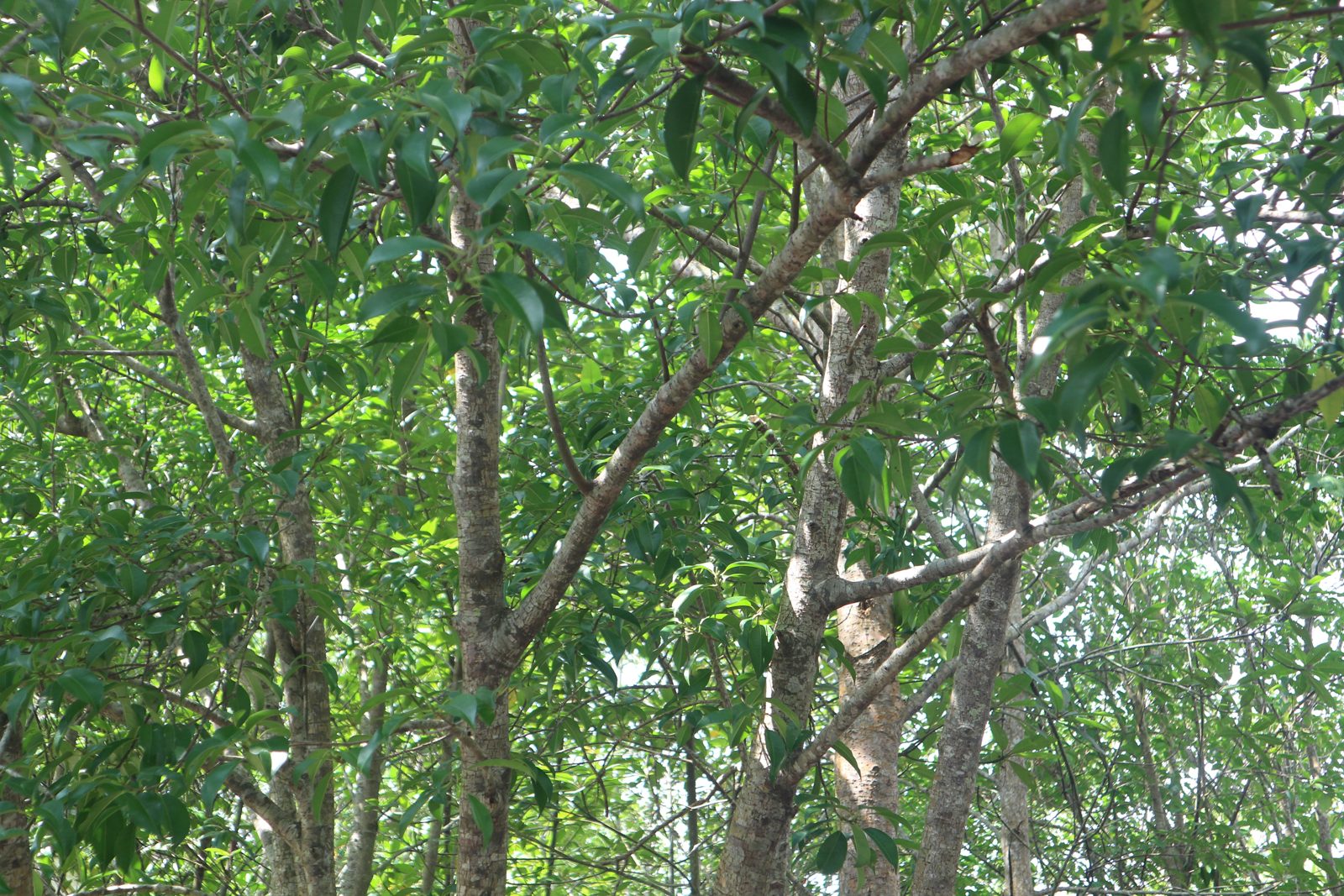
Field site, Bandar Bakau, Dumai, 2025. Field documentation, Mangrove Insight.
What does local knowledge mean for mangroves?
Scientific literature often uses the terms local ecological knowledge (LEK) or traditional ecological knowledge (TEK). Both refer to knowledge of nature that grows out of living with an ecosystem, is passed down, and is often built into customary rules.
Paulangan et al. (2026) stress that effective mangrove management requires integrating local ecological knowledge, customary institutions, and gender equity. The four examples below show what that looks like on the ground.
1. Tonotwiyat: the Women’s Forest of Youtefa Bay, Papua
In Enggros Village, Youtefa Bay, Jayapura, the community maintains Tonotwiyat, the “Women’s Forest”. Paulangan et al. (2026) studied the system over eight months.
The Women’s Forest is a culturally defined mangrove space where ecological functions, women’s food production, privacy, social interaction, and cultural identity are inseparable. Women harvest molluscs and crabs there.
What makes it work is its institutions. Tonotwiyat governs a shared resource through:
- clear spatial boundaries;
- women’s access rights;
- prohibitions on men entering certain areas;
- ethical harvesting norms;
- social monitoring;
- customary sanctions;
- collective deliberation.
The system is now under threat. Development pressure, land conversion, pollution, and restricted access threaten the remaining 173.47 ha of mangroves in Youtefa Bay (Paulangan et al., 2026). The researchers therefore recommend judging any infrastructure by whether it protects or disrupts women’s access, privacy, and harvesting routes.
2. Jaring Halus, Langkat, North Sumatra
Sahputra et al. (2022) assessed the sustainability of community mangrove management in Jaring Halus Village across four dimensions: ecological, economic, social, and cultural.
One finding stands out: about 97% of respondents strongly complied with mangrove forest management in the village. This compliance was linked to local wisdom in natural resource management.
That wisdom includes:
- The jamu laut tradition, a ritual honouring ancestors who are believed to bring welfare to fishers and coastal residents.
- Customary protected sites in the mangrove area, initiated by the community and then promoted by the government.
The stakes are real. Mangrove clearing near the village hit residents’ livelihoods hard, especially fish catches, which declined afterwards (Sahputra et al., 2022).
3. Bunaken National Park, North Sulawesi
Ogi et al. (2026) documented mangrove use in four communities: Bahoi, Sondaken, Alung Banua, and Mantehage. They used questionnaires, in-depth interviews, and field observation.
- Acanthus ilicifolius and Avicennia marina play central roles as sources of food and traditional medicine.
- Use falls into three main dimensions: food, medicine, and firewood.
- Each community has its own emphasis: Sondaken in firewood, Bahoi in traditional medicine, and Mantehage in knowledge of species diversity.
The key finding concerns how fragile this knowledge is: systematic documentation of mangrove ethnobotanical knowledge is still scarce, and most of it is passed down orally. Literature they cite stresses the need to document it before those oral traditions disappear (Ogi et al., 2026).
4. Mentawir, East Kalimantan
Mentawir Village lies in the area of Nusantara, Indonesia’s new capital. Geria et al. (2026) record that the community maintains ecological balance through traditional knowledge, including nature-based flood defences such as riverside bamboo buffers and estuarine mangrove conservation. There are also rituals for preserving mangroves.
The study also holds a bitter lesson. When traditional fields and ancestral mangroves were neglected or destroyed to supply the charcoal trade, the result was chronic flooding and other ecological problems (Geria et al., 2026). Residents are now showing interest in eco-cultural tourism in old forests and mangroves, balancing economic benefit with conservation.
The common thread
Across the four examples, a consistent pattern appears:
- Clear rules, enforced together. Spatial boundaries, access rights, and customary sanctions in Tonotwiyat, and customary protected sites in Jaring Halus.
- Compliance grows from values, not only regulations. For example, the 97% compliance in Jaring Halus.
- Direct benefits for residents: food, medicine, firewood, and protection from floods.
- The knowledge is fragile. Orally transmitted knowledge can be lost, and when traditional practices are abandoned, damage can follow, as in Mentawir.
For this reason, researchers urge that local knowledge be formally integrated, for example through customary access rights, participatory mapping, and community monitoring (Paulangan et al., 2026).
What about Riau?
We are documenting coastal communities’ traditional ecological knowledge in mangrove management in Riau Province through a 2025 DPPM research grant. We will share the results here once they are published in a scientific journal.
Read also: The Economic Potential of Mangrove-Based Products
References
All references below are open access.
- Geria, I. M., Handini, R., Nastiti, T. S., Juliawati, N. P. E., Fauzi, M. R., Wibowo, U. P., Purwanti, E., Setiawan, Y., & Kumara, I. N. I. (2026). Disaster adaptation wisdom and resilience mechanisms in the traditional settlement landscape of Mentawir Village, capital city of Nusantara, East Kalimantan. Jàmbá: Journal of Disaster Risk Studies, 18(1), a2006. https://doi.org/10.4102/jamba.v18i1.2006
- Ogi, N. L. I. M., Watung, F. A., Rampengan, M. M. F., Rogahang, M. T., Roring, V. I. Y., & Semuel, M. Y. (2026). Ethnobotanical study of mangroves from coastal communities of Bunaken National Park, Indonesia. BIOTROPIA, 33(3), 389–402. https://doi.org/10.11598/btb.2026.33.3.2748
- Paulangan, Y. P., Triyanto, Al Amin, M. A., Indrayani, E., Manalu, K. A. A., Rahareng, E. F., Ramba, F. Y., & Hisyam, M. (2026). Integrating indigenous women’s knowledge into mangrove management: The Tonotwiyat system in Papua, Indonesia. Ethnobotany Research and Applications, 35, 20. https://doi.org/10.32859/era.35.20.1-15
- Sahputra, E., Harahap, R. H., Wahyuningsih, H., & Utomo, B. (2022). Assessing the sustainability status of mangrove forest ecosystem management by coastal community in Jaring Halus Village, North Sumatra, Indonesia. Biodiversitas, 23(1), 1–9. https://doi.org/10.13057/biodiv/d230101