
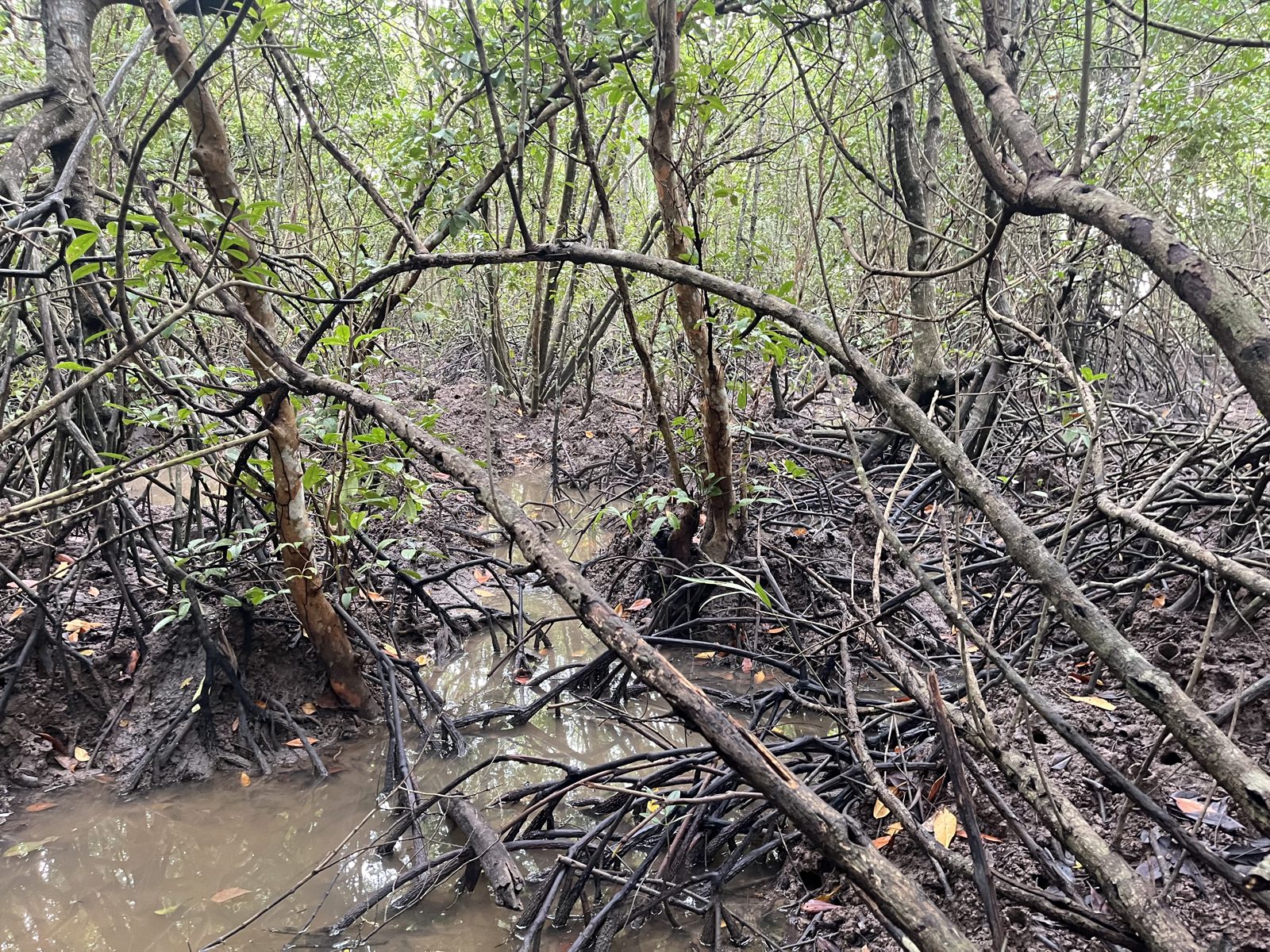
Many mangrove forests have been lost to aquaculture ponds, settlements, and timber needs. Silvofishery offers another path: raising mud crabs inside the mangrove forest, without cutting it down. This article summarises its application in the Meranti Islands, Riau, and compares it with experience in Sorong and Batam.
At a glance
- Silvofishery integrates mangrove conservation with brackish-water aquaculture, with low inputs (Budijono et al., 2020).
- In Meranti, 5 × 5 m fixed net pens produced crab growth of 100–140 g per month and 70% survival (Budijono et al., 2020).
- A calculation for one pen over 3 months showed extra income of about IDR 1.07 million per month, at 2019 prices.
- In Sorong, silvofishery mentoring increased crab productivity by up to 250% (Poltak et al., 2025).
What is silvofishery?
Silvofishery is an old concept in coastal management that integrates mangrove conservation with brackish-water aquaculture. It is a form of sustainable aquaculture with low inputs (Budijono et al., 2020). The principle is simple: protect mangroves by generating income from fisheries (Efendi et al., 2023). Raising crabs in pens under this system limits the clearing of mangrove forest.
Two basic models are common: the ditch-pond (empang parit) model and the alternating (komplangan) model, in which mangrove strips alternate with ponds (Budijono et al., 2020).
Why mud crabs?
Budijono et al. (2020) summarise the advantages:
- Mud crabs live naturally in mangrove forests, so there is no need to clear the forest. A fenced pen is enough.
- The forest provides suitable physical and chemical conditions.
- The forest provides natural food.
- Pens can be used to grow low-grade crabs up to export quality.
- The mangrove’s ecological functions are maintained, because no trees are cut.
Experience in the Meranti Islands, Riau
Background: a shrinking forest
Mangroves in Teluk Belitung, Padang Island, shrank drastically: from 299.31 ha (2000) to 14.53 ha (2015). A major cause was charcoal-kiln (panglong arang) activity (Budijono et al., 2020).
The study was carried out in Teluk Belitung and Bandul Village using field trials and interviews. Potential aquaculture land is spread across Padang Island, Tebing Tinggi, and Rangsang Island, totalling 438 ha. Water quality is suitable: mean temperature 28 °C, salinity 25‰, pH 8, and a sandy-mud substrate 80–100 cm thick (Budijono et al., 2020).
Field site, 2026. Field documentation, Mangrove Insight.
Building a fixed net pen
The technology is very simple (Budijono et al., 2020):
- Pen size: 5 m × 5 m × 3 m.
- Walls: polyethylene (PE) netting with about 1-inch mesh, supported by timber and planks.
- Posts: driven 75–100 cm into the mud. The bottom of the net is also buried so crabs cannot escape.
- Mangrove vegetation is left inside the pen for shelter, shade at low tide, and leaf litter.
- A perimeter ditch 40 cm wide and 20–30 cm deep, so crabs can stay submerged at low tide.
- Old car tyres as hiding places from predators, a distinctive feature of the Meranti model.
Rearing
| Stage | Practice in Meranti |
|---|---|
| Seed crabs | Wild-caught via collectors, partly from Indragiri Hilir and Tanjung Balai Asahan |
| Stocking size | About 100 g/crab |
| Stocking density | 6 crabs/m³ |
| Feed | Trash fish, twice a day, 10% of total crab weight |
| Maintenance | Nets cleaned every two weeks |
| Rearing period | 2–3 months |
| Market size | 300–350 g/crab |
Source: Budijono et al. (2020).
Results
- Growth of 100–140 g per month, with 70% survival (Budijono et al., 2020).
- A trial in Indragiri Hilir recorded weight gains of up to 170 g/crab in one month from a starting weight of 90 g, with 70% survival.
- In Teluk Belitung, crabs reached 425 g from a starting weight of 150 g.
The economics of one pen
Budijono et al. (2020) calculated the economics of one pen over a 3-month cycle:
| Item | Value |
|---|---|
| Investment (netting, posts, planks, tools) | IDR 1,320,000 |
| Depreciation | IDR 132,000 |
| Operating costs (150 seed crabs + 25 kg feed) | IDR 1,025,000 |
| Total cost | IDR 2,477,000 |
| Revenue (sale price IDR 125,000/kg) | IDR 5,687,500 |
| Net profit | IDR 3,210,500 |
| Extra income per month | IDR 1,070,150 |
By this calculation, the investment can be recovered in one cycle under normal conditions, and the business can be run as a side business for farmers and fishers (Budijono et al., 2020).
Important: these figures are for one pen at 2019 prices. Prices of seed crabs, feed, and crabs change over time. Recalculate with local prices before starting.
Experience elsewhere
Kladufu, Sorong, Southwest Papua. Before mentoring, fishers caught on average only 2–3 kg per day. Some used poison and cut mangroves to make crab traps. Middlemen’s prices for premium crabs fluctuated between IDR 45,000 and 65,000 per kg. After extension, training, and hands-on silvofishery mentoring, 85% of participants could apply the techniques taught, 90% felt more confident, and crab productivity rose by up to 250% (Poltak et al., 2025).
Ngenang Island, Batam. Mangroves in Batam continue to degrade as development advances. On Ngenang, the silty loam soil was judged good at holding water, and natural crab food was plentiful: trash fish, small crabs, and mangrove gastropods. Mentoring shifted the fishers’ group from knowing little to knowing quite a lot about crab farming (Efendi et al., 2023).
Challenges to address
From these three experiences:
- Seed supply. In Meranti, seed crabs still come from the wild and from outside the regency. The researchers recommend the local government build a mud crab hatchery (Budijono et al., 2020).
- Carrying capacity. Mangroves are also used for tourism, charcoal production, and capture fisheries, so a carrying-capacity study is needed before expanding silvofishery (Budijono et al., 2020).
- Mentoring. Sorong and Batam show that training and hands-on mentoring determine whether the technique is actually adopted.
- Destructive practices must stop. Silvofishery loses its meaning if mangroves are still cut for traps or timber (Poltak et al., 2025).
References
All references below are open access.
- Budijono, Prianto, E., Hasbi, M., & Hendrizal, A. (2020). Pengembangan budidaya kepiting bakau (Scylla sp) sistem silvofishery untuk melestarikan hutan bakau di Kabupaten Kepulauan Meranti Provinsi Riau [Development of mud crab culture (Scylla sp) “silvofishery system” to preserve mangrove forest in Kepulauan Meranti District, Riau Province]. Jurnal Kebijakan Perikanan Indonesia, 12(2), 101–108. https://doi.org/10.15578/jkpi.12.2.2020.101-108
- Efendi, Y., Syamsi, F., Sari, N. P., & Agustina, F. (2023). Pemberdayaan masyarakat silvofishery kepiting bakau (Scylla spp) di Pulau Ngenang Kelurahan Ngenang Kota Batam [Community development: mud crab silvofishery on Ngenang Island, Batam City]. Minda Baharu, 7(1), 9–20. https://doi.org/10.33373/jmb.v7i1.5304
- Poltak, H., Ernawati, Ismail, Ndahawali, D. H., Puspitasari, A. W., Abadi, A. S., Kadarusman, Handayani, Saidin, Ghurdi, Hasan, F. I., Yani, A., Arif, D., Rusli, Lestariaji, C., & Tantri, A. F. (2025). Pengembangan sistem silvofishery untuk budidaya kepiting bakau berkelanjutan di kawasan mangrove Kladufu [Development of a silvofishery system for sustainable mud crab aquaculture in the Kladufu mangrove area]. Buletin SWIMP, 5(2), 10–18. https://doi.org/10.15578/bs.v5i2.83