
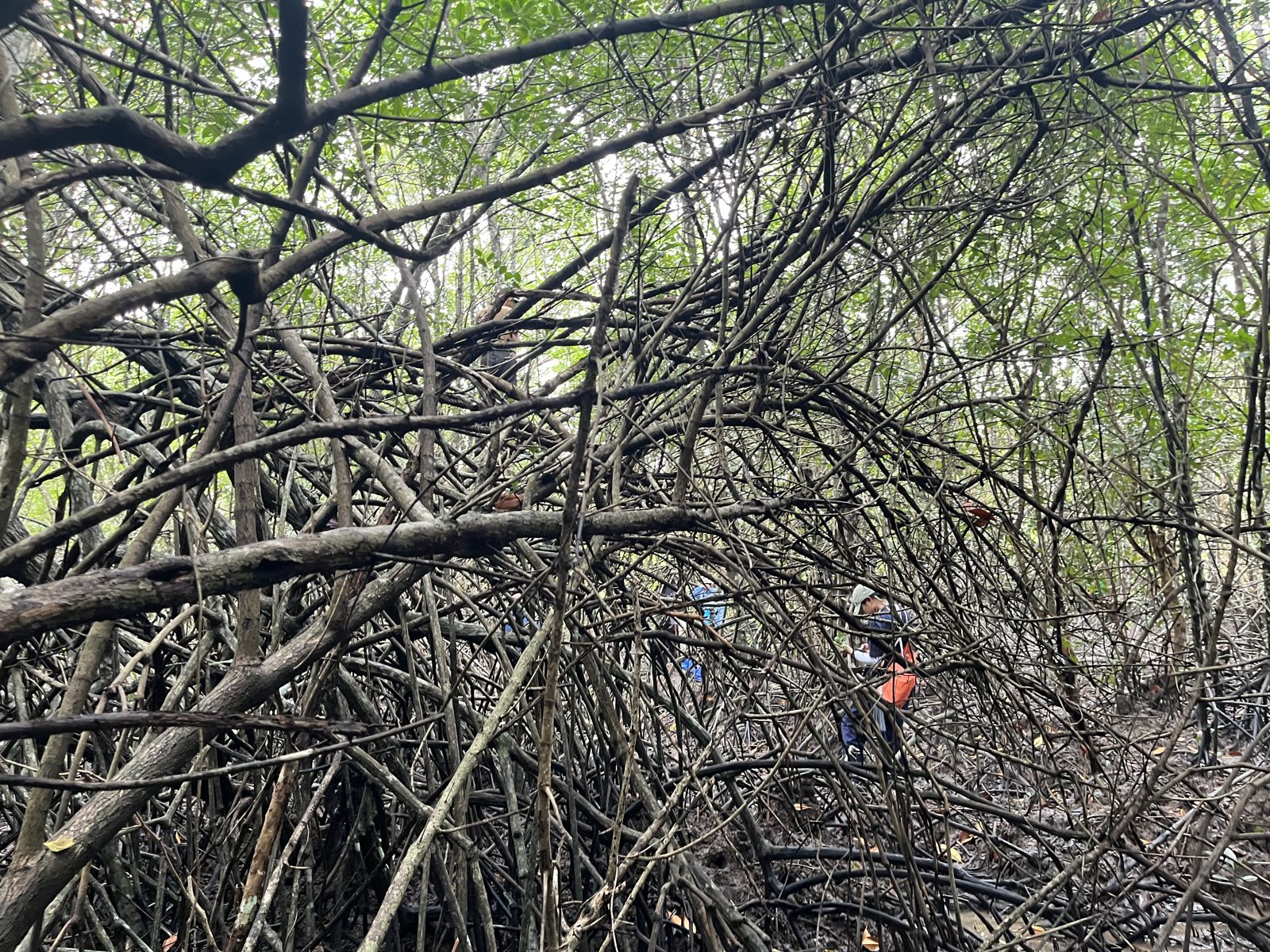
Dense mangrove roots hold mud, soften waves, and shelter fish and crabs. That same density also traps something unwanted: litter. This article summarises our study in Purnama Village, Dumai, and compares it with findings elsewhere.
At a glance
- In Purnama, Dumai, marine debris density reached 0.207 items/m² and 15.859 g/m² (Yoswaty et al., 2021).
- By weight, debris was dominated by plastic (50%), followed by processed wood (35%) and rubber (9%).
- In Pangandaran, 15 gastropod species were found attached to litter (Prasetiawan et al., 2023).
- Mangrove canopies and pneumatophores trap litter for long periods (Neelavannan et al., 2025).
Mangroves as a litter “net”
Mangrove ecosystems naturally act as traps for waste from human activities, including marine debris (Yoswaty et al., 2021). Litter from land and debris carried by tidal currents can be trapped and stored for a long time by the complex structure of the canopy and pneumatophores (Neelavannan et al., 2025).
Our study in Purnama Village
The study ran from April to July 2021 at two stations (Yoswaty et al., 2021):
| Station I | Station II | |
|---|---|---|
| Location | Sungai Masjid estuary | Coastal waters of the UNRI Marine Station |
| Substrate | Mud | Sand and clay |
| Mangrove species | Xylocarpus granatum, Rhizophora apiculata, Bruguiera gymnorrhiza | R. apiculata, X. granatum, Avicennia alba |
The Purnama mangroves lie near settlements, smallholder oil palm, palm oil (CPO) mills, and ports (Yoswaty et al., 2021).
How debris was collected: a 50 × 100 m plot was divided into five 50 × 20 m subplots, modified from the NOAA standing-stock method. All debris inside was collected and recorded by type, count, and weight (Yoswaty et al., 2021).
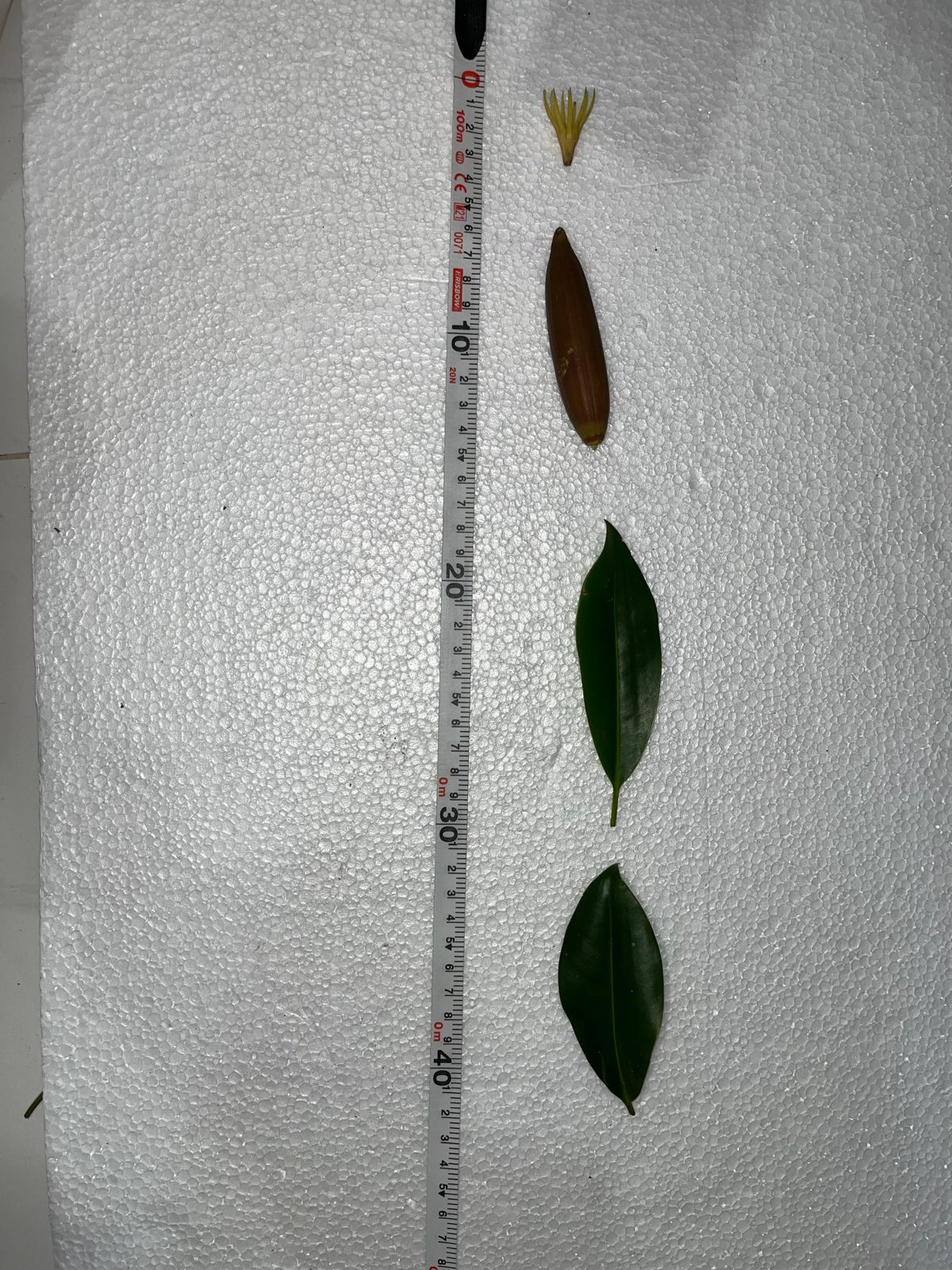
Bruguiera gymnorrhiza (Tumu), Purnama, Dumai, 2025. Field documentation, Mangrove Insight.
What we found
| Parameter | Station I | Station II |
|---|---|---|
| Items collected | 35 | 172 |
| Density (count) | 0.035 items/m² | 0.172 items/m² |
| Density (weight) | 3.194 g/m² | 12.665 g/m² |
| Mangrove density | 1,678 ind/ha | 2,222 ind/ha |
Source: Yoswaty et al. (2021).
Overall, debris density at Purnama was 0.207 items/m², or 15.859 g/m². By weight, it was 50% plastic, 35% processed wood, and 9% rubber (Yoswaty et al., 2021).
The plastic items were varied: styrofoam fragments, food containers, drink bottles, plastic fragments, medical masks, detergent and soap packaging, nappies, bags, lighters, gallon caps, and rope (Yoswaty et al., 2021).
Why was Station II so much higher? Debris at Station II was thought to come from community activities on land, dumped directly or indirectly into coastal waters. The low amount at Station I was thought to reflect rainfall: higher river discharge flushes debris from the estuary out to sea (Yoswaty et al., 2021). In general, marine debris comes from two main sources: household waste and land-based litter carried by rivers.
What about the forest? Both stations fell in the very dense category under Indonesian Ministry of Environment Decree No. 201/2004 (≥1,500 ind/ha). At the time of the study, debris was judged not yet to affect the existence of the mangrove forest in Purnama (Yoswaty et al., 2021). That is good news, and also an early warning: litter is building up in a forest that is still healthy.
What does other research show?
Litter becomes habitat. In the Bulaksetra mangroves, Pangandaran, Prasetiawan et al. (2023) recorded 22 types of debris, dominated by plastic. They found 16 gastropod species around the debris and 15 species attached directly to it. Plastic has become part of the mangrove habitat, and gastropods use it as a place to live. This is a serious concern because some gastropod species are eaten by local people.
Plastic dominates in many places. On the Gulf coast of Saudi Arabia, plastic made up 80% of litter items on the mangrove floor and 43% of items entangled in the canopy (Neelavannan et al., 2025).
Crabs are affected too. In Guanabara Bay, Brazil, litter was often found stuck to roots, crab burrows, and the substrate (de Almeida et al., 2026). Earlier studies they cite found a negative correlation between fiddler crab burrow density and litter cover, and impacts including the physical blocking of crab burrows.
Can the numbers be compared?
Neelavannan et al. (2025) reported a mean of 1.4 items/m² in Saudi Arabia, and cited 1.45 items/m² in Hong Kong, 1.29 items/m² in the Philippines, and 0.75 items/m² on Tunda Island, Indonesia. The Purnama figure (0.207 items/m²) looks lower, but do not rank them directly. Size thresholds, plot sizes, and collection methods differ between studies. Neelavannan et al., for example, collected all litter larger than 2.5 cm. A fair comparison needs the same method.
What can be done?
These steps follow directly from the findings above:
- Monitor regularly. The Purnama forest is still very dense. Routine monitoring lets changes be detected before it is too late.
- Stop it at the source. Because debris is thought to come from land-based community activities and rivers, managing waste in settlements and rivers matters more than just picking it up in the forest.
- Use a standard method, so results can be compared over time and between sites.
- Watch the wildlife. Litter that gastropods cling to and that blocks crab burrows shows the impact is not only about looks.
Need a marine debris and mangrove condition survey for a CSR programme or environmental study? See Mapping & Survey Services
References
All references below are open access.
- de Almeida, E. V., dos Santos, P. de O. G., Chequer, L. P. T., Gonçalves, V. D., Stauffer, T., Rage-Aboud, J. E., Sabino, C. M., Buraschi, G. V., & Vinzon, S. B. (2026). Marine litter is a notable challenge to crabs in highly impacted mangrove areas: A case study in Guanabara Bay, SE Brazil. Environmental Monitoring and Assessment, 198, 528. https://doi.org/10.1007/s10661-026-15341-x
- Neelavannan, K., Pulikkoden, A., Jinoy, G., Meleppura, R., Panickan, P., Rajaneesh, K. M., et al. (2025). Geospatial distribution and anthropogenic litter impact on coastal mangrove ecosystems from the Saudi Arabia coast of the Gulf. Scientific Reports, 15, 15964. https://doi.org/10.1038/s41598-025-98136-3
- Prasetiawan, N. R., Kurniasih, R. A., Damayanti, P. M., & Agus, M. (2023). Gastropods on marine debris at mangrove ecosystem. Jurnal Biodjati, 8(1), 54–68. https://doi.org/10.15575/biodjati.v8i1.20634
- Yoswaty, D., Amin, B., Nursyirwani, Diharmi, A., Wibowo, M. A., & Hendrizal, A. (2021). Analysis of marine debris and mangrove forest density in Purnama village, Dumai city, Riau province. IOP Conference Series: Earth and Environmental Science, 919, 012017. https://doi.org/10.1088/1755-1315/919/1/012017