
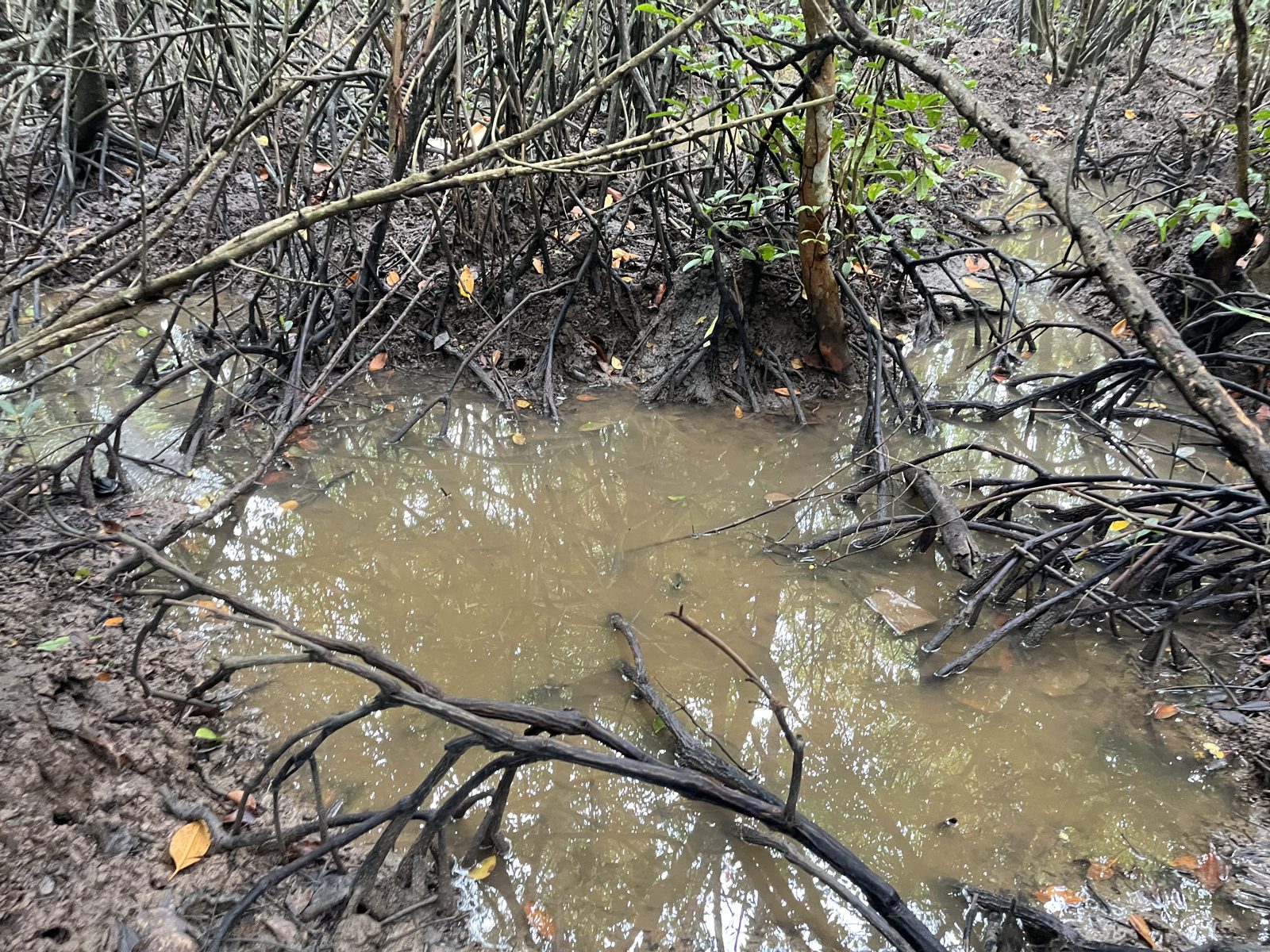
When people assess a mangrove forest, they usually look up: how dense the trees are, how tall, which species. Yet many answers lie underfoot, in the mud where the roots work. This article summarises our study in two villages in Lingga Regency and sets it beside other research to answer one practical question: what can soil data actually tell us?
At a glance
- In Bukit Langkap and Kerandin villages, mangrove soil pH ranged from 6.1 to 6.8, nitrogen from 0.12 to 0.19%, and texture was dominated by silt (59–61%) (Eddiwan & Hendrizal, 2024).
- These soil properties were almost the same in dense, medium, and sparse stands.
- A study in Mexico found silt content and pH to be the main factors linked to mangrove forest structure (Basánez-Muñoz et al., 2026).
- pH cannot be read on its own. Hydrology, oxygen, and sulfide also matter (Zhang et al., 2026).
Why does soil matter to mangroves?
Many abiotic factors shape where mangrove species grow: microtopography, salinity, flooding, the hydrological cycle, phosphorus and nitrogen availability, pH, redox potential, and sulfide concentration (Basánez-Muñoz et al., 2026).
Below ground, porewater salinity makes plants spend energy managing water and ions. Prolonged oxygen shortage and sulfide exposure can impair root metabolism (Zhang et al., 2026). So although mangroves are famous for tolerating salt and flooding, not every intertidal site suits every species or every growth stage (Zhang et al., 2026).
Our study in Lingga
The study ran from January to March 2024 in two villages in East Lingga District, Lingga Regency: Bukit Langkap and Kerandin (Eddiwan & Hendrizal, 2024).
The steps were:
- Choosing stations by vegetation condition: dense, medium, and sparse.
- Laying transects perpendicular to the coastline towards land, sampling at 0–10 m, 20–30 m, 40–50 m from the shore, and so on.
- Recording vegetation in 10×10 m plots for trees over 10 cm in diameter, and 5×5 m plots for saplings 2–10 cm in diameter.
- Analysing soil for texture, acidity (pH), and nitrogen content.
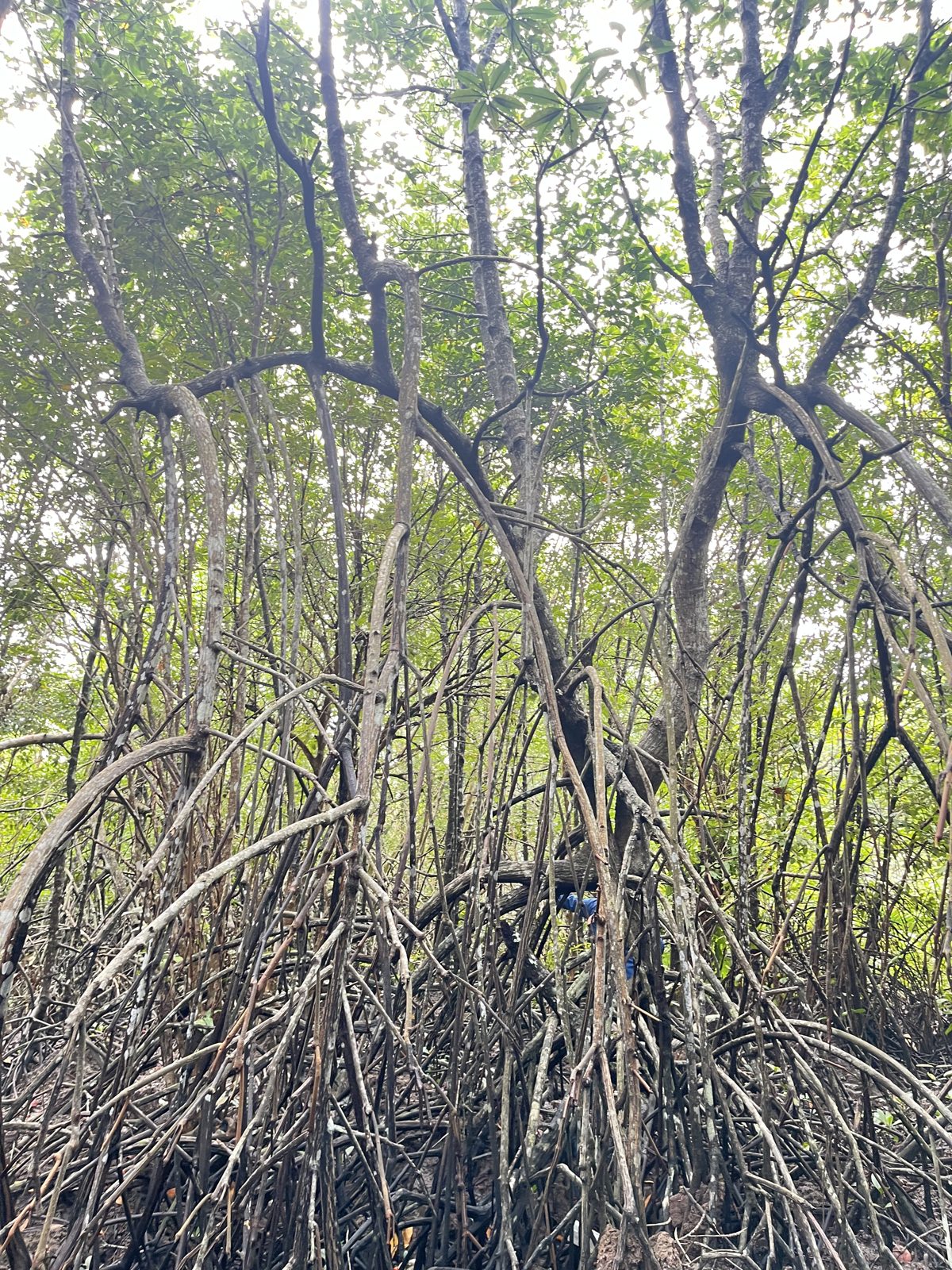
Mangrove roots and substrate, 2026. Field documentation, Mangrove Insight.
What we found
| Village | Density | pH | N (%) | Sand (%) | Clay (%) | Silt (%) |
|---|---|---|---|---|---|---|
| Bukit Langkap | Dense | 6.6 | 0.16 | 20 | 21 | 59 |
| Medium | 6.8 | 0.18 | 20 | 20 | 60 | |
| Sparse | 6.4 | 0.12 | 18 | 21 | 61 | |
| Kerandin | Dense | 6.1 | 0.15 | 17 | 22 | 61 |
| Medium | 6.4 | 0.18 | 19 | 22 | 59 | |
| Sparse | 6.8 | 0.19 | 19 | 21 | 60 |
Source: Eddiwan & Hendrizal (2024), Tables 1 and 2.
Three things stand out:
- pH 6.1–6.8, slightly acidic to near neutral. The paper’s conclusion judged this range still supportive of mangrove growth.
- Nitrogen was relatively low, at 0.12–0.19%.
- Texture was uniform. Every stand fell in the silt loam class, with 59–61% silt.
Just as important: the soil differences between dense, medium, and sparse stands were very small and showed no consistent pattern. In Kerandin the lowest pH was in the dense stand, while in Bukit Langkap the highest pH was in the medium stand. The study also did not test the soil–vegetation relationship statistically. So these data cannot yet explain why some forest is denser than other forest. The explanation probably lies in factors that were not measured.
What does other research show?
A study in Veracruz, Mexico, offers a useful comparison. Basánez-Muñoz et al. (2026) measured soil properties and forest structure in 100 m² plots along four transects perpendicular to the coast, in intact, semi-disturbed, and disturbed forest. They found:
- Silt content and soil pH were the main environmental factors significantly linked to variation in mangrove structure.
- pH was lower in apparently healthy forest (5.42) and higher in disturbed forest (6.43).
- The root cause was causeways built in 1988. They altered water circulation, soil properties changed, and the forest degraded.
The lesson: a pH of around 6–7 is not automatically “good”. The same number can mean different things depending on hydrology. Hydrology controls porewater salinity, oxygen availability, redox conditions, sulfide exposure, and sediment properties, which in turn shape root development and seedling survival (Zhang et al., 2026).
What does this mean for management and restoration?
- Measure soil together with hydrology. pH and texture data are most useful when read alongside flooding and water-flow patterns.
- Add parameters. Our study measured only pH, nitrogen, and texture. The literature shows salinity, redox, and sulfide also matter (Basánez-Muñoz et al., 2026; Zhang et al., 2026).
- Compare with a nearby healthy site. As in Veracruz, a local reference means more than an “ideal” textbook value.
- Test relationships statistically. Finding which factors truly relate to density needs more plots and analyses such as ordination or regression.
Need a mangrove soil and vegetation survey for your project? See Mapping & Survey Services
References
All references below are open access.
- Basánez-Muñoz, A. de J., Jordán-Garza, A. G., Serrano, A., & Twilley, R. R. (2026). Linking soil properties to mangrove structural parameters across a disturbance gradient in the Northern Veracruz, Mexico. Plant-Environment Interactions, 7(3), e70176. https://doi.org/10.1002/pei3.70176
- Eddiwan, K., & Hendrizal, A. (2024). The effect of soil environmental parameters on mangrove tree growth in Lingga District. Jurnal Penelitian Pendidikan IPA, 10(12), 10403–10409. https://doi.org/10.29303/jppipa.v10i12.9313
- Zhang, M., Zhang, H., Khalique, A., Hussain, Z., Bozdar, B., Hussain, M., Lee, F. W. F., Xu, S. J., Pan, M., Ng, T. W., Lang, T., & Ahmed, N. (2026). Environmental controls of mangrove propagule and seedling establishment: Salinity, hypoxia, sulfide, sediment instability, and early root function. Frontiers in Plant Science, 17, 1986366. https://doi.org/10.3389/fpls.2026.1986366