
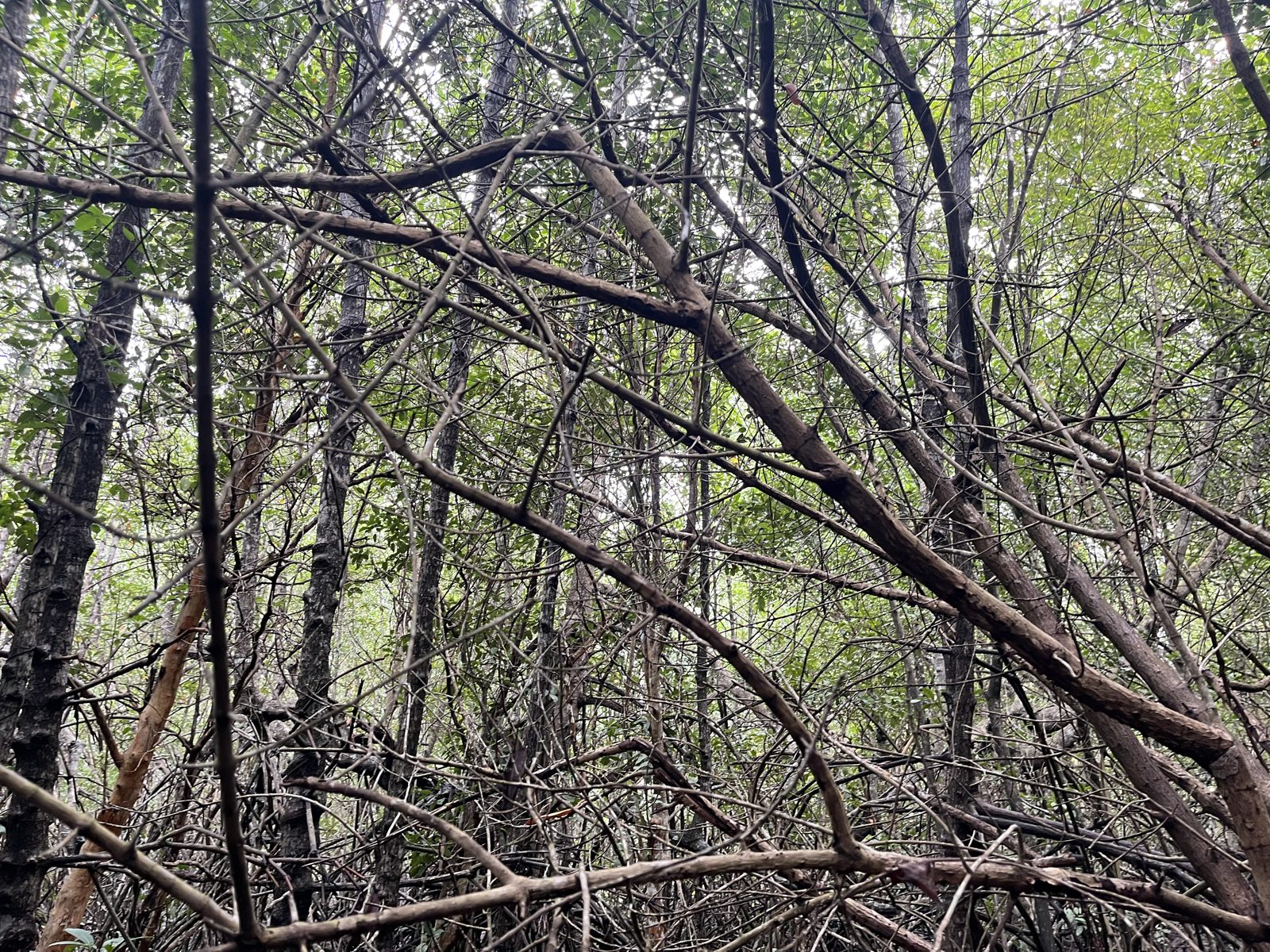
Photos of thousands of freshly planted mangrove seedlings always look promising. The problem is the photo rarely taken: the same site one or two years later. Research shows that restoration failure often stems from things that could have been foreseen from the start. This article summarises the main causes and how to avoid them.
At a glance
- Mangrove restoration projects often fail because hydrological conditions are disregarded (Van Loon et al., 2016).
- In Demak, Rhizophora mucronata had the highest survival (67%) but the slowest growth. Avicennia survived less well but grew fast and fruited within 16 months (van Bijsterveldt et al., 2022).
- Planting too densely can block natural regeneration (van Bijsterveldt et al., 2022).
- Recovery takes a long time: forests left to regenerate for more than 25 years only then matched the biomass carbon of intact forest (Sasmito et al., 2020).
Mistake 1: Ignoring hydrology
Van Loon et al. (2016) put it plainly: mangrove restoration projects often fail because hydrological conditions are disregarded.
Each mangrove species needs a particular flooding duration. In the hydrological classification they tested in Vietnam (Can Gio and Ca Mau) and Indonesia (Mahakam):
- At frequently flooded sites (class 2), only pioneer species such as Avicennia and Sonneratia can establish.
- Class 3 sites are the most diverse, suitable for Rhizophora, Ceriops, and Bruguiera.
The good news is that the classification needs little data: water levels over one lunar tidal cycle are enough. It is also more informative than measuring elevation alone. At one site, flooding lasted longer than expected from elevation, because water was ponding behind natural levees (Van Loon et al., 2016).
This matches other literature: hydrology controls porewater salinity, oxygen availability, redox conditions, sulfide, and sediment properties, all of which determine whether seedlings survive (Zhang et al., 2026). Mangroves’ tolerance of salt and flooding does not make every intertidal site suitable for every species.
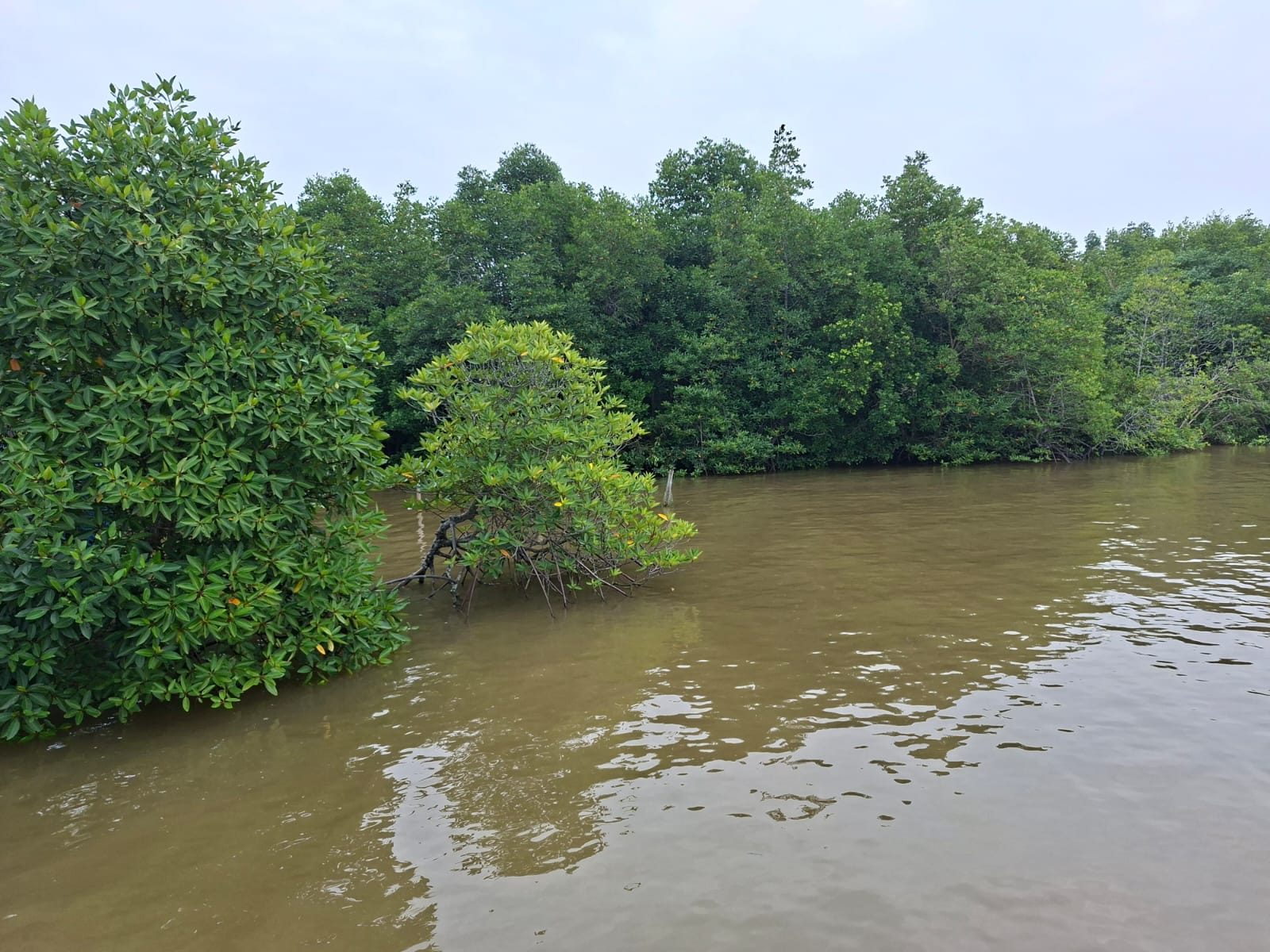
Field site, 2026. Field documentation, Mangrove Insight.
Mistake 2: Planting the wrong species in the wrong place
Along 20 km of the Demak coast in Java, seaward restoration was mainly attempted by planting Rhizophora (van Bijsterveldt et al., 2022). Their planting trials showed clear differences between species:
| Species | Survival | Growth |
|---|---|---|
| Rhizophora mucronata | 67% (highest) | Lowest |
| Avicennia alba | 35% | Much faster |
| Avicennia marina | 21% | Much faster; young trees fruiting within 16 months |
Source: van Bijsterveldt et al. (2022).
The lesson: survival rates alone can mislead. Pioneer species such as Avicennia lose more seedlings, but the survivors grow fast and soon produce fruit for the next generation. Species choice must follow site conditions, including the flooding class.
Mistake 3: Planting too densely
Even when planting “succeeds” in the sense that many seedlings survive, there is another risk. Seedlings are often planted so densely that the resulting stand leaves little light for natural recruitment, and succession is held back (van Bijsterveldt et al., 2022). The result can be a uniform plantation rather than a diverse mangrove forest.
Mistake 4: Forgetting natural regeneration
To overcome planting failures, experts are increasingly shifting towards habitat restoration that encourages natural recruitment (van Bijsterveldt et al., 2022). This approach is known as Ecological Mangrove Restoration (EMR): helping natural regeneration by restoring the habitat.
Three pieces of evidence from the literature:
- Propagule supply is often there. In Demak, propagules of pioneer species were up to 21 times more abundant in creeks of the pond zone than near their source in the coastal zone (van Bijsterveldt et al., 2022).
- Restoring water flow can be enough. A study they cite showed that digging a creek to reconnect water flow at a propagule-starved site triggered mangrove regeneration within 6.5 years.
- Sediment and wave barriers help. Another cited study found that sediment-trapping fences raised the bed and calmed waves, so natural seedlings increased from zero to 24,000 per hectare in 3 years.
Three “windows of opportunity” for seedlings
For propagules to establish on their own, they must pass three windows of opportunity: a flooding-free period, a wave-free period, and an erosion-free period (van Bijsterveldt et al., 2022). EMR works by extending these windows. Planting larger seedlings can be an option at sites too harsh for small seedlings, because taller seedlings can persist where new ones would be uprooted.
Mistake 5: Ignoring land subsidence
In Demak, permeable brushwood dams could not keep pace with land subsidence to expand mangroves seaward, but they did increase the survival of seedlings already planted compared with more wave-exposed sites (van Bijsterveldt et al., 2022). On sinking coasts, expectations must be adjusted.
Mistake 6: Expecting instant results
Restoration is not a one-season project:
- In West Papua, logged forests left to regenerate for more than 25 years only then reached the biomass carbon of intact forest (Sasmito et al., 2020).
- Conversion to aquaculture ponds removed 60% of soil carbon and 85% of biomass carbon (Sasmito et al., 2020). Damage like this does not heal quickly.
- In Thailand, ponds abandoned for 10 years still held far less carbon, while those abandoned for 15 years were no longer significantly different from intact mangrove forest (Elwin et al., 2019).
So monitoring must continue for years, not stop after the planting ceremony.
So, plant or not?
The answer: it depends on the site. Van Bijsterveldt et al. (2022) concluded that EMR has potential in the pond zone, since propagules were shown to reach well into the backwaters. In very challenging coastal zones, mangrove recovery can be encouraged by combining EMR with planting of pioneer species.
A checklist before planting
Built from the studies above:
- Measure hydrology: record water levels for at least one lunar tidal cycle and determine the flooding class (Van Loon et al., 2016).
- Check for natural propagule supply. If it exists, prioritise restoring habitat and water flow.
- Match species to flooding class: pioneers for frequently flooded sites, Rhizophora and similar species for higher ground.
- Do not plant too densely; leave room for natural regeneration.
- Account for waves, erosion, and subsidence.
- Plan long-term monitoring, not just a count of seedlings planted.
🌱 Planning Mangrove Rehabilitation?
We help assess site suitability through vegetation surveys, mapping, flooding measurements, and species recommendations, before the first seedling goes in.
Read also: How Much Carbon Do Mangrove Forests Store?
References
All references below are open access.
- Elwin, A., Bukoski, J. J., Jintana, V., Robinson, E. J. Z., & Clark, J. M. (2019). Preservation and recovery of mangrove ecosystem carbon stocks in abandoned shrimp ponds. Scientific Reports, 9, 18275. https://doi.org/10.1038/s41598-019-54893-6
- Sasmito, S. D., Sillanpää, M., Hayes, M. A., Bachri, S., Saragi-Sasmito, M. F., Sidik, F., et al. (2020). Mangrove blue carbon stocks and dynamics are controlled by hydrogeomorphic settings and land-use change. Global Change Biology, 26(5), 3028–3039. https://doi.org/10.1111/gcb.15056
- van Bijsterveldt, C. E. J., Debrot, A. O., Bouma, T. J., Maulana, M. B., Pribadi, R., Schop, J., Tonneijck, F. H., & van Wesenbeeck, B. K. (2022). To plant or not to plant: When can planting facilitate mangrove restoration? Frontiers in Environmental Science, 9, 690011. https://doi.org/10.3389/fenvs.2021.690011
- Van Loon, A. F., Te Brake, B., Van Huijgevoort, M. H. J., & Dijksma, R. (2016). Hydrological classification, a practical tool for mangrove restoration. PLoS ONE, 11(3), e0150302. https://doi.org/10.1371/journal.pone.0150302
- Zhang, M., Zhang, H., Khalique, A., Hussain, Z., Bozdar, B., Hussain, M., Lee, F. W. F., Xu, S. J., Pan, M., Ng, T. W., Lang, T., & Ahmed, N. (2026). Environmental controls of mangrove propagule and seedling establishment: Salinity, hypoxia, sulfide, sediment instability, and early root function. Frontiers in Plant Science, 17, 1986366. https://doi.org/10.3389/fpls.2026.1986366